
How can AI understand, discover, and design the physical world?
Embedding conservation laws, governing equations, physical boundary conditions, and domain knowledge into machine learning models to build scientific AI that is physically plausible, mathematically accurate, and computationally stable. The Yun-Tian Chen team is developing a closed-loop framework of “knowledge embedding—data learning—knowledge feedback” to address problems in complex industrial and energy systems characterized by limited data and strong physical constraints; Dongxiao Zhang has long been conducting interdisciplinary research integrating stochastic modeling, numerical computation, and machine learning for energy and subsurface engineering.
Why it matters
Traditional engineering models rely on complete equations and extensive computation, while purely data-driven models are often constrained by insufficient data and poor generalization capability. Integrating physical knowledge with AI has the potential to simultaneously push the boundaries of model accuracy, computational efficiency, and scientific discovery capability, thereby establishing a new computational paradigm for future engineering science.
Topic
Knowledge-Embedded Scientific Machine Learning
Our contributions
- Embedding conservation laws, governing equations, physical boundary conditions, and domain knowledge into machine learning models to build scientific AI that is physically plausible, mathematically accurate, and computationally stable. The Yun-Tian Chen team is developing a closed-loop framework of “knowledge embedding—data learning—knowledge feedback” to address problems in complex industrial and energy systems characterized by limited data and strong physical constraints; Dongxiao Zhang has long been conducting interdisciplinary research integrating stochastic modeling, numerical computation, and machine learning for energy and subsurface engineering.
Application areas
- Fluid mechanics
- energy systems
- underground engineering
- complex industrial processes
- digital twins
- fast surrogate models
AI for Scientific Discovery
Our contributions
- Not only does AI fit existing data, but it also extracts unknown laws from experiments and observations through symbolic learning, equation discovery, and data-driven analysis. The Yun-Tian Chen group has conducted systematic research on automated equation discovery, including identifying governing equations from complex data and exploring the use of larger-scale mathematical knowledge to train scientific discovery models—advancing from “AI for prediction” toward “AI for discovery.”
- Meanwhile, the Yu Zhou group’s research shows that the large volume of data generated by AI during aerodynamic optimization can itself reveal new scaling laws and flow control mechanisms in reverse, thereby closing the loop between engineering optimization and fundamental scientific discovery.
Application areas
- Discovery of unknown governing equations
- mechanism identification of complex systems
- experimental data analysis
- discovery of new material laws
- fluid and energy sciences

Industrial Intelligence & Autonomous Systems
Our contributions
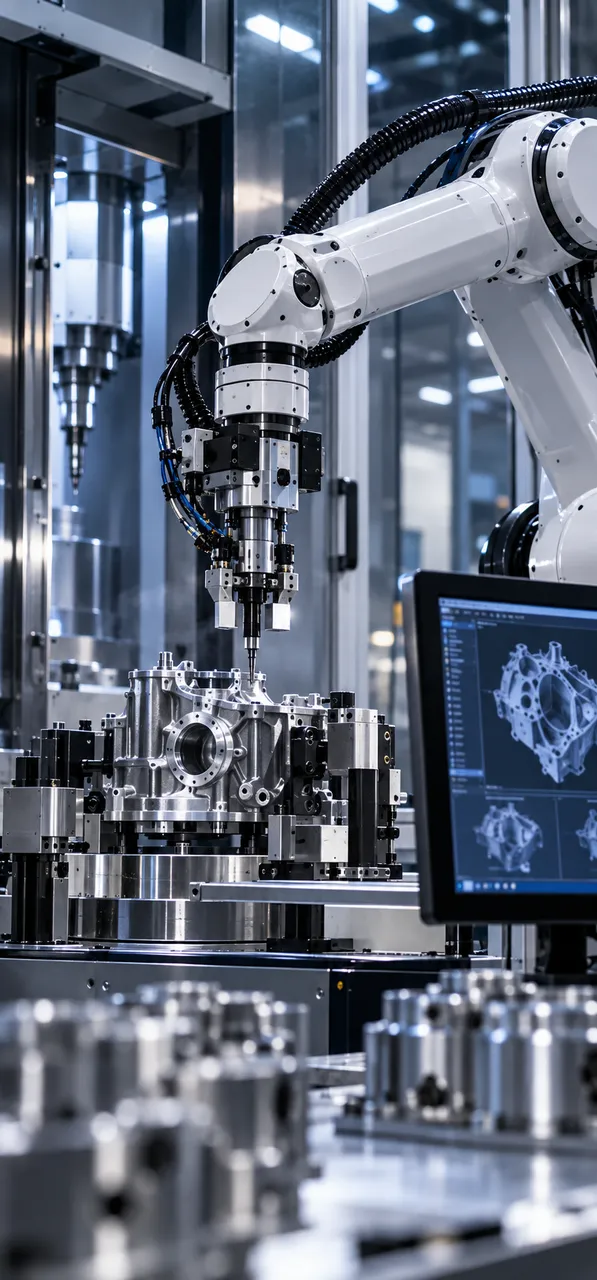
- Centered on the complete chain of perception–recognition–prediction–decision–control, we develop industrial artificial intelligence, pattern recognition, multimodal perception, human–AI interaction, and autonomous control technologies. Yi-Fan Zhao’s research spans machine learning, digital twins, computer vision, and human–machine collaboration, with applications in aircraft design and operations, intelligent manufacturing, autonomous driving, and smart construction; Yu Zhou further introduces AI closed-loop control into real-world complex flow systems.
Application areas
- Intelligent Manufacturing
- Aviation Operations and Maintenance
- Autonomous Driving
- Robotics
- Autonomous Equipment
- Smart Construction
- Control of Complex Industrial Systems